

 The Las Vegas Radio Amateur Club, Inc. (LVRAC), the oldest amateur radio club in Las Vegas, has been active in the Clark County community since April 1961 and is an ARRL (The National Association of Amateur Radio) Affiliated Club.
Radio amateurs, often called “hams,” enjoy radio technology as a hobby. Ham radio operators are men and women of all ages and walks of life who are linked by their interest in wireless communications technologies. Hams are all licensed by the Federal Communication Commission (FCC), and provide a significant amount of public service to the community.
The club supports public service organizations such as Red Rock Search and Rescue and assists local government agencies in time of need when regular communication systems fail or are overloaded. Many of the LVRAC members also belong to the Amateur Radio Emergency Service (ARES) which is a volunteer emergency communications organization supporting local, state and federal government agencies.
LVRAC provides volunteers to assist in wireless communications for local area events like the Silver State Classic Road race and the annual Baker to Las Vegas foot race supporting Nevada and California police agencies. Members of the club also volunteer to assist charitable organizations with their fund raising events; including the Susan G. Komen Cancer Organization where our hams provide the communications to coordinate their annual Las Vegas race; the National Nurses Association’s annual half marathon; the American Diabetes Association bicycle race, and many other local non-profit organizations. LVRAC promotes interest in Amateur Radio through general education in communications technologies to schools and youth groups such as the Boy Scouts.
LVRAC also provides and maintains a radio communication network consisting of VHF and UHF repeaters that cover the Las Vegas valley and Clark County. This repeater system (call sign K7UGE) has a VHF repeater located atop the Westgate Casino and Hotel operating on a frequency of 146.940 Mhz. using a PL tone of 100.0 Hz. Please feel free to join us if you are a licensed Ham or just listen in if not yet a Ham, on the Weekly LVRAC Nets that are held every Tuesday and Thursday evenings at 7:00PM local time on the K7UGE repeater system.
If you are a new Ham or just want to understand a little more about this great hobby, LVRAC holds regular meetings on the third Wednesday of every month, starting at 6:00 PM for a “Social Hour” with the general meeting being called to order at 7:00 PM local time, located at the Red Rock Search and Rescue building, 330 Villa Monterey Dr., Las Vegas, Nevada. All are welcome and we encourage you to become a member of the Las Vegas Radio Amateur Club.
LVRAC is a nonprofit corporation registered in the State of Nevada and recognized under the IRS code 501(c) (3). Donations to the Club are tax deductible and always welcome.
A Brief History Of the LVRAC
The LVRAC was formed in April of 1961, and is the oldest HAM radio club in Las Vegas. It began in Jerry Mann’s kitchen (W7VYC later N7CAH now SK). The first meeting was held as a picnic at Mt. Charleston, 150 people attended.

In the early days of the LVRAC the club was contacted by Joe Wells, then the head of the Thunderbird Hotel, who wanted to establish a ham station in the hotel. He offered to purchase the equipment and provide a room in which to build a station. He bought a full Collins Radio S-line system (the finest equipment made at the time), Hy-Gain beam antennas and all the necessary accessories to equip a fully functional station. A glass windowed room, completely visible, to the hotel’s patrons, was built to house the station. All LVRAC members had station access key cards and could operate the station at any time. Club meetings were held at the hotel. The colorful “Thunderbird ” is our current logo as a symbol of the club’s early affiliation with the Thunderbird Hotel more than a half of a century ago.
by Luke R. – KK7BW
When Tubes Glowed and Cocktails Flowed
Imagine strolling through a Strip casino, finding a fully equipped ham shack and firing up a state of the art station. In the early days of the LVRAC, that’s just what you could do.
It’s a springtime day in 1963 and you’re driving north on the Strip.
Just south of Sahara, off to the right, you are caught off guard by a sight as startling as the jolt of a rare DX station coming back to your CQ.
Because you’re an amateur radio operator, you often keep an eye out for antennas when you’re driving around. But an antenna behind one of the hotels on the Las Vegas Strip?
What’s this all about?
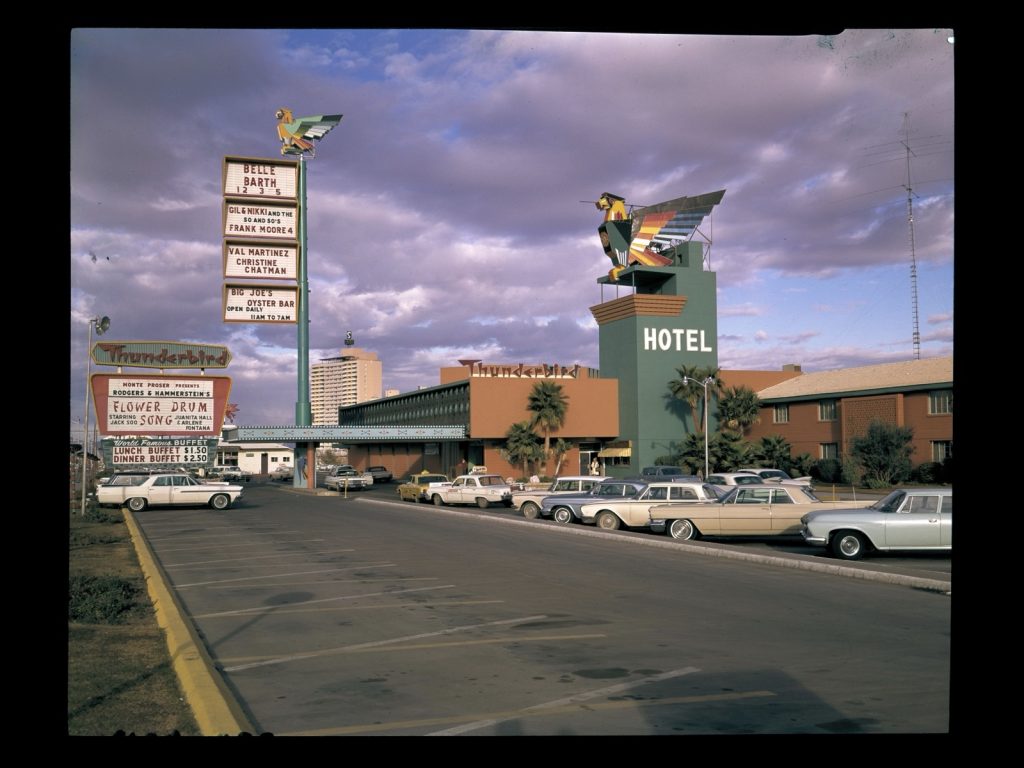
You pull in to The Thunderbird Hotel, park and stroll around back for a closer look.
(You can see the antenna off to the right in this photo, courtesy of the UNLV Special Collections and Archives.)
It turns out to be an array of Hy-Gain beam antennas.
“A rotor is clearly visible about 6 feet down from the top of the tower,” says Fred, K5LX, who eyeballed this picture for us.
“It’s located inside the tower and turns both beams and the discone antenna on top. There is a long mast which has all the antennas on it and sits on top of the rotor. Also, there is probably a thrust bearing right at the top of the tower which bears the weight of the antennas, mast and cables.
“You can’t see it, but there’s almost certainly one there because it takes most of the weight off of the rotor and puts it on the tower. This is common practice in big antenna installations.”
…
How did this come to be? How did antennas that would be the envy of any amateur operator of the early 1960s wind up on the Las Vegas Strip?
We can thank Joe Wells, who ran the Thunderbird Hotel. Joe reached out to our club, told us he was interested in building a complete amateur station and asked for our guidance. Joe then pulled out the Thunderbird’s checkbook and ordered top notch equipment.
The Thunderbird station was set up inside the hotel for guests to admire. It served as an attraction for our hobby, whetting the appetites of Vegas visitors with an interest in getting involved with amateur radio.
But this was not just a glittering display. The station, anchored by Collins S-Line equipment, was regularly operated by LVRAC members.
In 1963, Collins S-Line gear was widely admired and acclaimed. The S-Line replaced the A-Line, fondly known as “The Gold Dust Twins” in 1958.
“The initial S-Line consisted of the 32S-1 transmitter and the 75S-1 receiver,” says LVRAC member Steve, K7EAU.
“In the post-World War II period, Collins was established as the premier manufacturer of amateur radio equipment. Although quite costly, Collins equipment excelled in both quality of construction as well as performance.
“The Collins mechanical filter offered selectivity unattainable with conventional circuitry. The Collins permeability tuned oscillator (PTO) provided for a very stable and linear VFO. The dial readout had a one kilocycle (as it was called back then) resolution. A number of companies tried to offer a lower cost alternative to the S-Line, but none could approach Collins quality and performance.”
…
Gone are the days of Collins transmitters and receivers as state of the art equipment. Gone are the days of hotels such as the Thunderbird. And largely gone are creative entrepreneurs such as Joe Wells who enjoyed the freedom to bring his widespread interests to life at a Strip hotel without countless corporate signoffs.
(As an aside, Joe was the father of the Gilligan’s Island actress Dawn Wells, who played the role of Mary Ann.)
In the days when LVRAC members operated from and met at the Thunderbird, the hotel was a favored after-hours haunt for Vegas hotel employees.
Many a night, dealers and bartenders, cocktail waitresses and showgirls would gather at the Thunderbird. Most hotels in town had their own unofficial table. While Collins equipment purred away behind the glass of the station’s dedicated shack, the nearby Turquoise Room and The Topaz Lounge sizzled with glamour and excitement.
Today, the Las Vegas Radio Amateur Club pays tribute to this once magical hotel with our Ten Meter Thunderbird Net, every Sunday night at 7:00P Pacific Time on 28.420 kHz. You’re more than welcome to join us.
Here at the LVRAC, we look back fondly on this era of Vegas history, a charming time when tubes glowed and cocktails flowed.
by Paul – K7RKO